In the world of professional sports, scouts are one of the most important people in an organization. They are a fundamental part of talent evaluation for the future of the franchise, and they see more games and videos of players than anyone else in hockey. A hockey scout operates in the background. Think about all 32 NHL teams, can you name their scouts? More likely, you’ll be able to name some general managers, coaches, and of course the players. But scouts? Only the most avid hockey fans would know their organization that well!
What is the Role of the Hockey Scout?
So what is the role of the scout? The goal of their work is a forward-looking process. Think about where the franchise is at right now, and where they will be in two, five, or ten years. What kind of talent will they need? Are major contracts coming up where the organization can fill those roster spots with youth? Does the free agent class for goaltenders look particularly shallow in a few years? If that is the case, the organization may want to draft a goalie in the draft and develop the talent from within.
Proper talent evaluation and planning can set the franchise up for years. But there is more to a scout than just going to watch hockey games. Some scouts will focus on junior or college players and who is coming down the pipe for the NHL draft. Others will keep an eye on other professional leagues around the world, where NHL teams may be able to work on signing an unknown player, or at the very least drafting them.
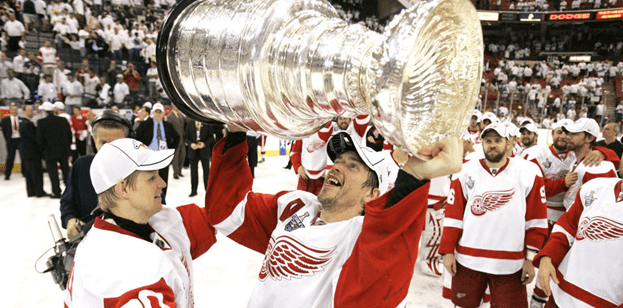
The Detroit Red Wings come to mind here. The team sent their head of European Scouting Hakan Andersson to Russia to scout defenseman Dmitri Kalinin. After watching the game Andersson noticed Datsyuk more than Kalinin. Andersson made the effort to go to watch Datsyuk again, a process that required obtaining a travel visa each time he entered the country. When Andersson made his case to the Red Wings front office, they trusted his judgment and selected Datsyuk.
The rest is history: Datsyuk helped the Wings to two Stanley Cups, he won four consecutive Lady Byng trophies for the best sportsmanship in the NHL, and three consecutive Selke trophies for the best defensive forward. If Andersson hadn’t traveled to the far reaches of Russia to watch the games in the minor leagues, Datsyuk may have never been discovered. Andersson’s is an example of a scout gaining complete trust at all levels of the organization. He also went on to scout former captain Henrik Zetterberg, Johan Franzen, and Tomas Holstrom all from his native Sweden.
Who Are Hockey Scouts?
Generally, hockey scouts are people who have been around the game, and have some experience both playing and coaching. Talent evaluation is a major part of the job, so it definitely helps to have been a player at some high level. A lot of scouts around the NHL are ex-players, and having that eye for what intangibles a player possesses at such a young age, is key to their development into professional players.
What do Scouts Look For?
After a certain level, most players are highly skilled, so scouts definitely need to watch for what sets these players apart from the pack. Of course, hockey scouts look for what the player can do on the ice: skating, shooting, hockey sense, finishing checks, and effort are all things that can help a scout take notice of a specific player. We know for Andersson, he noticed that Datsyuk was incredibly skilled at anticipating the moves of his opponents, and breaking up plays with his stick. That kind of hockey sense is not always teachable, so if a player can come with that inherent skill, it’s less work for the organization in the long run.
Another side to player evaluation is how that player acts and carries himself off the ice. Andersson was intrigued by Datsyuk after he brought a Russian translator with him to speak with Datsyuk following the game, but Datsyuk refused. For some scouts that could have been a red flag that the player has some personality issues off the ice, or just isn’t interested in playing in the NHL. Luckily for Red Wings fans, Andersson persisted and went back to watch Datsyuk again.
Scouts also need to see if the player’s game is transferable to the NHL. Hockey in Europe is so different from hockey in North America, with larger rink sizes, less physicality, and less dumping and chasing. Andersson had to determine if Datsyuk’s skill set translated to the NHL game. He noted that Datsyuk was small, but that he was strong on his skates, even though his skating technique was unorthodox. Remember, players in these remote minor Russian leagues are not really comparable to NHL opponents, so success in Europe does not necessarily mean success in the NHL.
How do you become a Hockey Scout?
Being a hockey scout sounds like a fun job, but there’s a lot of hard work that goes into it as well. First, you’ll definitely have to put your time in with an organization and get the front office and executives to trust your judgment.. For as many success stories of players like Datsyuk come out of the NHL draft, there are likely ten or twenty times as many stories of draft picks being failures. We’ve seen entire scouting groups be relieved from their positions if a team struggles for an extended period of time.
So for those who want to become hockey scouts, just don’t expect to be hired in the NHL from off the streets. Being an NHL level scout takes years of recognition and trust, and it certainly helps to have played the game at the highest level. You need a great eye for talent and that extra ability to recognize true talent in an environment completely different from the NHL. Andersson most likely had many failures as a scout, but for these few successes he had, the Red Wings won multiple Stanley Cups and dominated the NHL for more than a decade.
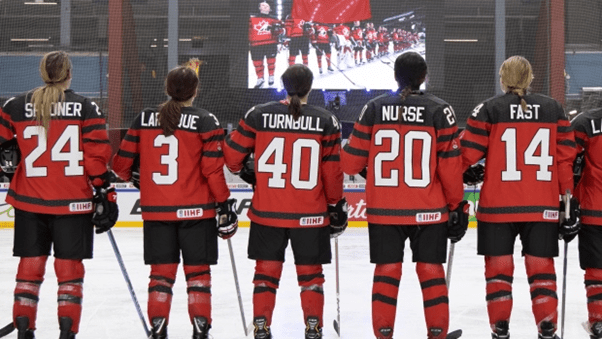
It is a great divide that we are still trying to cross in our everyday world, let alone sports. The gender gap is a real social dilemma and whether it is about opportunities or the differences in how much men and women are paid, the fact is, in many ways our society is still a male-dominated world. Leagues like the WNBA and the NWSL are breaking down barriers for female athletes around the world, and hockey isn’t too far behind. Recently the PWHPA (Professional Women’s Hockey Player’s Association) continued its Dream Gap Tour for a second season, as the organization pushes for a North American professional women’s league. The PWHPA played its first official women’s hockey game at Madison Square Garden, a historic event for women’s hockey everywhere.
We all remember the legends of the game that paved the way for young female hockey players around the world. Manon Rheaume stood tall as the first woman to ever play a professional sport in North America. Hayley Wickenheiser and Cammi Granato led the first generation of women’s hockey stars and are rightfully considered to be two of the best to ever suit up. But there are often women behind the scenes, working for NHL front offices and helping the league function on a day to day basis. Recently the NBA and NFL have both embraced hiring female coaches and executives, something that was unheard of until the last few years. Let’s take a look at some of the most powerful women in the NHL and how they are changing the game for the better.
Dawn Braid
Braid was the first woman to ever be hired into a full-time coaching position when she became the skating coach for the Arizona Coyotes in 2016. She has also worked with the Toronto Maple Leafs, Buffalo Sabres, Anaheim Ducks, and the Calgary Flames in various capacities. Braid worked with the Coyotes for two years before leaving the organization to return to consultant work.
Kim Davis
Davis was hired in December of 2017 as the new Executive Vice President of Social Impact, Growth Initiatives, and Legislative Affairs for the NHL. She works tirelessly with grassroots hockey across North America to ensure that a strong and diverse culture is enforced from a young age. As the NHL becomes more diverse both in terms of gender and culture, Davis is the one leading the charge, creating a league where all individuals are welcomed and celebrated.
Heidi Browning
Browning is the current Chief Marketing Officer for the NHL and has the task of drawing interest to hockey at a time where the internet and social media rule. She has started numerous programs including NHL Power Players, which empowers teenagers to help provide feedback and suggestions on how the NHL can better relate to the youth of today. Browning also helps the NHL players market themselves, whether it is building their own brand online or helping them find a platform to help the community.
Cassie Campbell-Pascal
Another legend as a former player, Campbell-Pascal is now trailblazing in the announce booth too as one of the new hosts of Hockey Night in Canada. She has become a mainstay on broadcasts and has provided poignant insights and demonstrated a vast knowledge for the game. She has paved the way for more women broadcasters around the league, and joins a growing contingency of female broadcasters in nearly every professional sport.
Susan Cohig
Cohig is the Executive Vice President of Club Business Affairs, which is a fancy way of saying she ensures NHL teams have their ducks in a row. Cohig is instrumental in things such as the recent expansion team in Las Vegas as well as the upcoming debut of the Seattle Kraken. She has also played a large role in getting female players involved in the NHL all star festivities as well as the extremely popular women’s hockey rivalry series between Canada and the U.S.A.
Cammi Granato
We already mentioned Granato once earlier, but she definitely deserves her own spot as she was recently named the first ever NHL pro scout by the Seattle Kraken. She was hired by another powerful woman, the Director of Hockey Operations in Seattle, Alexandra Mandrycky. There have been female amateur scouts in the past, but Granato is raising the bar, showing that when it comes to identifying talent on the ice, women are just as impactful.
Hayley Wickenheiser
Often called the Wayne Gretzky of women’s hockey, Wickenheiser is now the Assistant Director of Player Development for the Toronto Maple Leafs. She is actively in charge of monitoring the progress and performance of Toronto’s farm system and prospects. Wickenheiser continues to work hard in growing the popularity of women’s hockey with initiatives like her WickFest girl’s hockey tournament.
Katie Million
Million is the USA Hockey Director of Women’s National Team Programs, so she is directly responsible for the recent success of the U.S. Women’s hockey program. She took over the position in 2019, after the U.S. Women’s team won Olympic Gold, and one of her main goals is to repeat in 2022. She is now one of the most powerful figures in the U.S. women’s hockey program, and is tasked with continuing the mounting success that the country has come to enjoy.
Lindsay Artkin
Did you know there is an NHL Coach’s Association? Well Lindsay Artkin is the president of it and is ensuring that the path is cleared for women who want to get involved in coaching at the professional level. Do not be surprised if we see some bigger names in the world of women’s hockey behind the benches of NHL teams at some point in the near future, especially as the role of coach in the NHL continues to evolve!
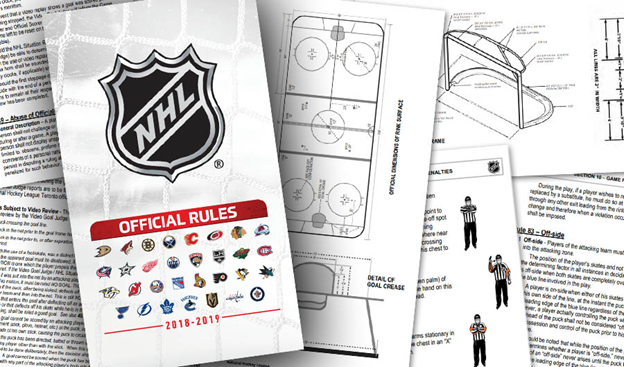
If you really think about it, hockey itself is a very strange game. It’s exhilarating and a joy to play, but when you really deconstruct the game, it is a little funny to think about. A bunch of players skating around and chasing a piece of rubber with bent sticks? Imagine trying to explain that to someone who has never heard of hockey before! Well isn’t it fitting then that a strange game like hockey has some really strange rules that the players must abide by? We know about all of the normal rules that come up during a broadcast, but what about some of the more absurd rules that we rarely ever get to hear about? Let’s take a look at some of the strangest rules in the sport of hockey!
Goalies must use white tape on their stick
Does it get any more absurd than controlling the colour of the tape that a goaltender can use for their stick? Well, apparently it is something the NHL is serious about because it is right in the official NHL rulebook. NHL Rule 10.2 states that ‘In the case of a goalkeeper’s stick, there shall be a knob of white tape or some other protective material approved by the League’. Why is the league so specific about the colour of the goalie’s stick tape? Likely to give the ref or goal judge a clear and unobstructed view of where the puck is. When you put it that way, it makes sense. If there is a scramble in front of the net, one could mistake the knob of the goalie’s stick for the puck. So, as strange as the rule might seem, it actually works in the goalie’s favour.
Teams Can Only Have One Goaltender on the Ice
What? This seems pretty obvious doesn’t it? Why would a team ever think to have more than one goalie on the ice? Wait, when you say it like that, it’s brilliant! Can you imagine the anarchy on the ice if a team were allowed to send out a second goaltender? Imagine a 5 on 3 penalty kill with one skater and two goaltenders guarding the net. It would make for some pretty entertaining games and a major change in strategy. Actually, goal scoring would be way down in hockey if there were two goalies guarding the net so it is probably for the best that NHL Rule 5.3 exists in the NHL rulebook.
If No Refs or Linesman Are Able to Officiate, Players Can Take Over
These rules just keep getting more absurd the more you read them. But this is another rule that is officially in the NHL rulebook. The exact wording states that: if, through misadventure or sickness, the Referees and Linesmen appointed are prevented from appearing, the League will make every attempt to find suitable replacement officials, otherwise, the Managers or Coaches of the two Clubs shall agree on Referee(s) and Linesman(men). This is a long way of saying that if there are no officials and the league cannot find any replacements, then players from each side will have to officiate their own game. It brings me back to the days of street hockey where you call your own penalties and high sticks. Now I know this would probably never actually happen in an NHL game, but it’s hard to imagine how players would be able to stay unbiased. Would you call a penalty on your own teammate? Or call back a goal for your own team?
Too Many Men? It Could End Up in a Penalty Shot
Wait, isn’t too many men on the ice just a regular minor penalty? Well yes it is and it isn’t. If there are too many men on the ice accidentally then it is a minor penalty. There are those who have done it on purpose in the past though, and the league has had to change their rulebook accordingly. Legendary coach Roger Neilson would push the boundaries of the NHL rulebook all the time. In this case, Nielsen would continue to send out players while killing off a 5 on 3 penalty, knowing that his team couldn’t be penalized anymore. There have been other times when coaches have purposely interrupted a breakaway or an odd-man rush by sending another defender over the boards. It seems like a smart strategy doesn’t it? So smart that the league had to incorporate this rule to penalize teams with a penalty shot if they send too many men onto the ice intentionally.
A Team Cannot Just Bring a Goalie in for a Penalty Shot
So say your team has just intentionally sent too many men over the boards and were penalized with a penalty shot against. How can this coach mess with these officials even more? By trying to switch out their goalie for the backup goalie who is sitting on the bench. That seems like it is breaking the rules, right? Well, technically you can swap out your goalie for a penalty shot, you just can’t swap back after the penalty shot is over. Coaches will have to wait until the next whistle or stoppage in play if they wish to bring their starting goaltender back into the net. Why is this? I’m not really sure and with this rule, I couldn’t even come up with a logical reason from the league. Interestingly enough, coaches can switch goaltenders during the shootout when a game is not resolved during an overtime period. If the coach knows that one goalie handles penalty shots better than the other, then switching to that goalie in the shootout makes sense. The new goalie would also be fresh, having not played for the previous 65 minutes of game action!
Fans of today’s NHL may not recognize a lot of the names on this list but that is just because the game has evolved so much. Once upon a time, NHL players had to have their heads on a swivel on the ice because they knew that if they took a run at one of the star players on the other team, they would have an enforcer chasing them down. While we still have fights in today’s game, enforcers have evolved into players who also need to contribute in other ways like scoring goals or killing penalties.
A couple of decades ago enforcers had one role on the team: fights. What some casual hockey fans may not understand is that hockey fights do indeed serve a purpose in the game and are not just a contest in machismo between two goons. First of all, hockey fights send a message to the other team. Second, it is either a momentum stopper or a momentum starter. The tide can turn on a dime if a losing team player wins a fight and rallies his bench behind him. Finally, hockey fights can settle scores as there is an unwritten rule that if you made a dirty hit or injured a player, you will have to pay the price at some point.
So it is interesting how much the game has changed over the years. Hockey has become faster, more skilled, and dictated by analytics. There is not much room for players who strictly fight, now that things like the salary cap and analytical matchups dominate the way teams are built from the ground up. Let us take a look at some of the best enforcers the game has ever seen.
Gordie Howe: Wait what? Mr. Hockey himself? Most people know Howe as one of the greatest offensive players of all time as he is currently fourth all-time in NHL career points scored. But did you know he had 1685 penalty minutes over his 1767 game career? Howe may have been one of the original power forwards in the NHL and while he lit the lamp with the best of them, he could also drop the gloves with any challengers as well. After all, a Gordie Howe hat trick is when a player scores a goal, gets an assist, and has a fight in the same game.
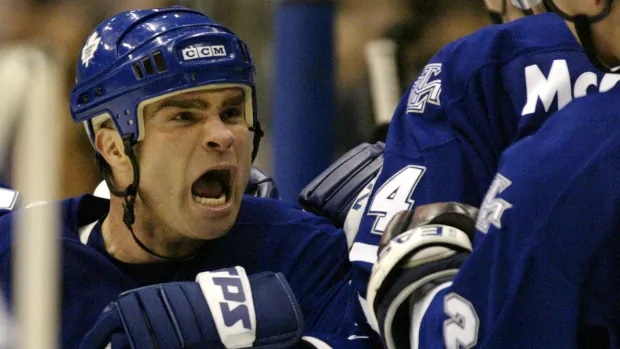
Tie Domi: Always a fan favourite while he played in Toronto, Domi was one of the premier enforcers in the 90’s. If you want to see what a classic NHL enforcer was like, look at Domi’s career stat line: 1,020 games played, 245 career points, and 3,515 penalty minutes, good for third all-time in NHL History. Yes, Domi averaged about 3.5 PIM per game over his career. Domi was the epitome of the saying, “it’s not the size of the dog in the fight, it’s the size of the fight in the dog,” as he tipped the scales at 213 lbs and was only 5’10”. These days, his son Max Domi plays for the Columbus Blue Jackets, and he definitely carries himself in the same way that his father did, except that Max already has more points than Tie in only 375 career games.
Marty McSorley: The personal bodyguard of Wayne Gretzky in Los Angeles, McSorley was one of the grittiest and toughest defenseman ever to play the game. McSorley finished his career with 3,381 penalty minutes in 961 games played, good for fourth all-time in NHL history. McSorley won two Stanley Cups in his career, but unfortunately he may best be known for his vicious slash against Donald Brashear that ended in a lengthy suspension.
Bob Probert: One of the most imposing enforcers of all-time, Probert weighed in at 6’3” and 225 lbs of pure muscle. Probert finished fifth all-time in career penalty minutes with 3300 in 935 games played. Probert spent his career split between Detroit and Chicago, but he is best known for his years cruising the ice at Joe Louis Arena, where in 1987, Probert racked up an impossible 398 penalty minutes in one season!
Tiger Williams: The all-time leader in career penalty minutes, Tiger Williams had nearly 4000 penalty minutes in only 962 career games. Tiger played with a number of teams over his career but he is best known as the enforcer for the Vancouver Canucks when they went on their Stanley Cup run in 1982, before losing to the New York Islanders. How tough was he? His real name was Dave.
Zdeno Chara: Here is one many of the younger hockey fans will know, the current captain of the Boston Bruins has had a storied career which includes a Stanley Cup and a Norris trophy. At 6’9” and 250 lbs, he is one of the largest players ever to hit the ice, and you can imagine how dominant he would be in a fight. Anytime someone challenges Chara, it turns into him ragdolling the other player around the ice as if he were a toy.
Stu Grimson: While he does not have the penalty minute totals or as long of a career as some of the others on this list, the Grim Reaper was one of the most feared hockey fighters throughout his career. In 729 career games, Grimson had 2,113 penalty minutes, and 39 career points. You can imagine what his role was on the team.
Rob Ray: Ray dominated NHL fighters throughout the 90s and into the 2000s and was well-known as an all-time popular Buffalo Sabre. Ray had 15 straight seasons of 90 or more penalty minutes, including back to back 350 penalty minute seasons from 1990-1992. Talk about consistency!
Craig Berube: That is right, the current head coach of the St. Louis Blues had a real mean streak when he patrolled the ice. Berube is seventh all-time in career penalty minutes with 3,149 in 1,054 games played. Berube had 16 seasons of 100 or more penalty minutes, including 15 straight seasons at one point in his career.
Brendan Shanahan: Yes another current hockey executive, the president of the Toronto Maple Leafs, was one of the greatest power forwards in NHL history. Not only did Shanny pot over 1,300 career points in his career, but he tallied 2489 penalty minutes as well! Shanahan won three Stanley Cups in his career and is a member of the Hockey Hall of Fame.
Since its formation in 1917, the NHL has showcased to the world the peak of hockey talent and skill.
Some of the most intelligent and experienced people manage million-dollar hockey franchises that draw massive fanbases from all over the world. Some of the most knowledgeable and courageous people coach the NHL teams that clash year after year, each contending to win the coveted Stanley Cup. Some of the most athletic and skilled people play on those NHL teams, working tirelessly day after day to hone their hockey skills so that they can help drive their team to victory.
But sometimes a general manager makes a trade that destroys any hope of their team winning. Sometimes a coach can’t avoid their team losing 15-0 despite their best efforts. Sometimes a player scores on his own net.
Even though the NHL is the apex of hockey skill, managers, coaches, and players are far from perfect. Mistakes happen, and when they do, we love it.
Here are 5 of the biggest blunders in NHL history:
5. The Rangers Lose 15-0 to the Red Wings, 1944
The worst loss in NHL history belongs to the New York Rangers when they lost 15-0 to the Detroit Red Wings on January 23, 1944. This loss was so outstanding that the record has stood for 76 years, despite tens of thousands of NHL games having been played since.
Most hockey fans today couldn’t fathom the terrible performance it would take to let in 15 goals in a single game—double-digit-goal games are incredibly rare. To be fair, it couldn’t have been any easier for Frank Boucher, the Rangers’ coach at the time, to watch an endless stream of pucks fly into his net.
To make matters worse, most of the 15 goals were scored in the second half of the game, during which the Red Wings averaged nearly one goal every two minutes.
After the Red Wings were finished pommeling the Rangers, New York didn’t win another game for the rest of the season. Talk about performance anxiety!
4. Brian Burke Trades the World to Have Phil Kessel on the Leafs, 2009
On September 19, 2009, the Maple Leafs’ general manager Brian Burke made a questionable trade that he thought would finally get the Leafs back into the playoffs after 5 years.
At the time, Boston Bruins newcomer Phil Kessel looked like a shining star. In his breakout season with Boston, Kessel scored 36 goals, and his performance was only predicted to improve in later years.
So, what made the trade such a terrible blunder?
Burke’s mistake was the price he paid to acquire the breakout star. In exchange for Kessel, Burke gave the Bruins his first- and second-round draft picks for the 2010 draft and his first-round pick in the 2011 draft.
At the time, Burke figured that if Kessel could help lead the Leafs to the playoffs (and to a Stanley Cup victory), then the price would be well worth paying. Unfortunately, although Kessel played well while on the Leafs, his performance wasn’t enough to lead the Leafs anywhere promising—the very season they acquired Kessel, the Leafs finished last in their division.
Worse yet, the Bruins used the draft picks that Burke had given them to their advantage. In the 2010 draft, the Bruins picked up Tyler Seguin and Jared Knight. That season, the Bruins won the Stanley Cup while the Leafs were left in the dust.
3. Marc Bergevin (St. Louis Blues) Tosses the Puck into His Own Net, 2000
What’s worse that scoring a goal on your own net with your stick? Scoring on your own net by casually tossing the puck with your hand.
Playing for the St. Louis Blues, Marc Bergevin accidentally scored on his own net while trying to glove a puck out of the way in a game against the San Jose Sharks on December 7, 2000. Bergevin caught the puck in mid-air, but rather than guiding it away from the only spot you don’t want the puck to be, he accidentally tossed the puck behind his goalie. It was the easiest goal that San Jose ever scored.
At first, none of the players or officials realized that the puck was in the net. After all, nobody had taken a shot. It looked like the puck had just disappeared or that Bergevin had held onto it for way too long. But, once the officials reviewed the tape, they confirmed that Bergevin had indeed guided the puck into his own goal.
2. Steve Smith (Edmonton Oilers) Scores on His Own Net, Costing Oilers the Game, 1986
One of the earliest-known blunders in NHL history is when Steve Smith of the Edmonton Oilers scored on his own net during a game against the Calgary Flames on April 30, 1986.
At the time of Steve’s mistake, the score was tied 2-2 in the third period. The Oilers goalie, Grant Fuhr, gave the puck to Smith just behind the Oilers’ net. Smith then attempted to clear the puck by making a long outlet pass to a teammate. Attempted is the key word. Smith botched his aim on the pass, and rather than make it to his teammate, the puck only travelled one or two feet before bouncing off one of Fuhr’s feet and into the goal.
Smith’s mistake gave the Flames a 3-2 lead, which the Oilers couldn’t overcome.
1. Patrik Stefan (Dallas Stars) Whiffs Easy Goal on Empty Net, 2007
Missing a shot on an open net from far away is bad. Missing a shot on an open net from right in front of it is worse. Missing a shot on an open net from right in front of it and then falling down is the worst blunder in NHL history. Thank you, Patrik Stefan.
On January 4, 2007, Dallas Stars player Patrik Stefan whiffed an easy goal on the Edmonton Oilers’ empty net.
The score was 5-4 for the Stars at the time when Stefan managed a breakaway approaching an empty net. He confidently skated up to the net in what looked like a guaranteed goal, but somehow fumbled the puck as he skated right by, failing to even take a shot. As soon as Stefan realized his mistake, he tried to turn himself around to take another shot, but his disorientation led to him simply crashing onto the ice as he lost control of the puck.
If Stefan had made the goal, the score would have been 6-4, likely ensuring the win for the Stars. Instead, once Stefan fell, the Oilers regained control of the puck and tied the game literally 10 seconds later.
Coincidentally (or not), Stefan’s playing career ended a mere 13 games after his colossal mistake