The mental side of hockey is one that does not get mentioned much by the media, but players are certainly becoming more candid about it. Being a professional athlete is often glamorized and any criticism of them is justified due to their million dollar paychecks. But hockey is becoming an increasingly open space for players to talk about the toll the game takes on their minds and not just their bodies. Las Vegas Golden Knights goaltender Robin Lehner is well known for openly talking about his bi-polar disorder, ADHD, and addiction problems. Former Vancouver Canuck goaltender Corey Hirsch has spoken candidly about his depression to the point of contemplating suicide.
The Mindset of a Hockey Goalie
The mindset of a goalie is so much different from players both on and off the ice. It is akin to other ‘island’ positions like being a baseball pitcher or football quarterback: the outcome of the game is nearly always a direct reflection of their in-game performance. When you think about it that way, it should not be surprising that goalies put so much pressure on themselves before every game.
Have you ever seen a goalie in pregame warmups? A lot of them have quirky little superstitions that they need to do before every game. Marc-Andre Fleury and Patrick Roy are both known for actively talking to their goalposts before and during the game. If you think about it, being a goalie can be a pretty lonely and isolating position. While players get to converse on the bench between shifts and skate around the ice, goalies more or less have to stay within their crease the entire game.
Part of why having the right mindset for goalies is difficult is because there are things that happen that are out of their control. Pucks can be deflected or the goalie can be completely screened on a shot, and if the goal goes in the goalie will always shoulder the blame. It is similar to how baseball hitters can fail 70% of the time at the plate, and still be considered a world-class hitter. It isn’t about the failures and the mistakes, it is the successful part of being a goalie that we should be focusing on.
When you are a goalie, there is nobody there to back you up if you are out of position or let out a juicy rebound. A defenseman always has their partner, and a forward can always cover backchecking for a linemate, but a goalie is on their own in the crease. Any goalie can have the perfect form and positioning, and still let in goals from anywhere on the ice. That is what can be so frustrating for those striving for perfection. Hirsch has been quoted as saying that being an NHL goalie is 80% mental and says that the perfect balance is staying mentally alert and sharp while staying physically relaxed. If your mindset in the crease is strong, then your physical abilities will follow almost like a reflex.
Unfortunately for goalies, you are only as strong as the ability to shake off the last goal you let in. If you dwell on mistakes and allow them to remain on your mind, then it will be difficult to ever regain your composure. Goalies need to learn to deal with disappointment and imperfection: you can’t reasonably expect to post a shutout in every game you play in. Even the best pitchers allow homeruns, the best quarterbacks throw interceptions, and the best goalies let in goals. It is the nature of sport, and the true measure of mental toughness is being able to overcome these disappointments and focus on the things that you can control.
The Mindset of a Hockey Player
Players have it easy! Well, that’s not exactly true, but there is definitely less individual pressure on players than on goalies. As a player, you can make a mistake on the ice and it does not necessarily mean that the game is lost. When you are a goalie, every shot against you and every goal you let in has the potential to lose the game. It is a strikingly different mindset for players than for goalies.
But it’s not that players do not put pressure on themselves. Have you ever heard of the phrase, ‘they’re squeezing their stick’? This is referring to players that are in a scoring slump and are squeezing their stick harder in order to try and score a goal. Prolonged slumps can be detrimental to a player’s confidence, especially when you consider just how difficult it can be to score a goal on the ice.
NHL players have been known to head out to the ice before warmups to visualize what is going to happen later in the game. It’s not so much imagining yourself scoring goals, but it provides a mental reassurance when the game actually starts. Imagining yourself making positive plays can help bolster your confidence, and can eliminate mental blocks when you are actually on the ice.
One thing that can really help players regain confidence is to learn from your mistakes on the ice. Just as goalies need to deal with letting in goals, defenders need to learn how to forget giveaways and forwards need to get past missing a golden opportunity to score. Do you think basketball players think about every shot they have missed? You are never going to be perfect on the ice so don’t let any mistakes you have made affect your ability to learn from them to improve your game in the future.
When players have a positive mindset, it helps their teammates out too. If you are showing negative body language on the ice and on the bench, it weighs on your linemates as well. Mastering the skill of having a positive mindset will not only help you to overcome mistakes, but it will allow you to re-focus on the things you are doing right on the ice.
Out of all of the sports that young athletes can play, it is difficult to think of one that is more physically intensive on developing bodies than hockey. A high impact game that is traditionally hard on knees and hips, the topic of potential overtraining from a young age has been a popular one in recent years. Why is overtraining suddenly a hot topic? Because studies of injuries amongst younger athletes have shown that a good percentage of them occur due to the neglect of recovery and fatigue in crucial areas of their bodies. As parents and coaches we have a tendency to overlook injuries in young players as their energy levels and flexibility tend to diminish how serious the injuries really are.
Overtraining on and off the Ice
Hockey has long been known as a sport that tends to have a lot of practices and games throughout the week. Early morning practices and late night games wreak havoc on the development of young bodies and not just because they spend too much time on the ice. Overtraining and fatigue can come in many different forms including a lack of sleep to a developing body. We all know kids need their sleep but early morning practices are not just hard on parents they are hard on the players as well. Not only can this hinder a full night’s sleep, but rushing to school after a practice can cause missing breakfast which is another essential building block for a developing body. What about when they actually get to school? A lack of sleep and breakfast can cause issues with focus and paying attention in class which of course is another aspect of mitigating full development.
What about physical development as well? To account for the amount of skating and physicality of hockey, players need to build up their strength which may include weight lifting or strength training off the ice. Younger players generally have what is called an imbalance of muscles, meaning that there are a lot of weaknesses in how their bodies are developing with certain muscle groups growing faster and stronger than others. This is natural as we rely on things like our legs more than we need upper body strength as children. Without proper training though muscle imbalances can become an issue and with prolonged weakness, can be a recurring source of injuries as we get older.
What about the goalies?
Hockey goalies by nature have a relatively unnatural stance when they are in the crease getting ready to stop the puck. Their legs are always slightly bent and pushing off in this crouched and compact position to explode into a save can cause long-term issues. One of the things many goalies have to deal with are hip issues like impingements or muscle tears in the labrum area. Recently, former Vancouver Canuck and Carolina Hurricane goaltender and friend of mine Eddie Lack was forced to retire due to chronic and recurring hip injuries. Goalies who play in net since childhood most likely suffer from some sort of hip pain or discomfort during their career and hip surgery is a common procedure that goalies need to undertake.
So how can we realistically say that multiple practices per week on top of games is helping young goalies avoid serious hip injuries in the future? The crouched position that goalies take is called the valgus position, and in this stance, the space between the labrum and the hip socket is diminished causing long-term wear and tear. Goalies also feel related knee soreness and suffer knee injuries from this stance so you can quickly piece together how overtraining as a goalie can have serious future repercussions to a goalie’s livelihood. The key to avoiding injury from any sort of repetitive stance or muscle use is stretching both before and after games and practices. There are numerous stretches that can target the hip and pelvis area for goalies, but with constant use over time, it may be inevitable for goalies to have some sort of hip issue.
Recovery is Key for Young Players
This is recovery in general, not just after injuries or soreness. One way to avoid overuse of the same muscle groups and joints is to have them take part in different sports throughout the year. Give their knees and hips a break with sports like soccer or baseball when hockey is in the offseason. The problem is, especially here in Canada where hockey is gospel, parents tend to keep their kids in hockey all year round. Spring and summer leagues are becoming more normal and if they are not playing in a league they often have them in other training camps like power skating. Is that wrong? Of course not, many parents have high aspirations for their children at a young age. They do need to know that twelve months of hockey could be doing some detrimental damage or at least not allowing for enough recovery for their muscles and joints.
Since young players bounce back so fast and are always wanting to get back out on the ice, they may not feel the same soreness that we feel as adults. Always make sure to be aware of any soreness your child may be feeling after a practice or game. If that soreness is not properly healed, it can make the area susceptible to injuries in the long-term. The key to not over train is to include diversity in your child’s activities throughout the year. Remember that proper sleep, nutrition, and rest are perhaps more important to their overall development than having four practices and two games per week. We are not just training our kids to be hockey players but we want them to develop the proper strength and physical health to succeed at everything in life, not just hockey.
There are currently 31 active NHL teams, and each has a roster of 23 players that participate in a season. That means that every year, the NHL features around 700 players.
But the NHL doesn’t feature the same 700 players season after season. Some players retire and others are drafted from lower levels to take the place of the retirees. Most people know what’s going on with the 700-or-so athletes in the spotlight while the NHL season is underway.
But what happens to the NHL players who retire?
Some ex-NHL players fall back on the money they made from the sport and retire from working in general. Other ex-NHL players still have the motivation to work but completely switch careers like Sean Avery, who took up modelling and restaurant management after ending his 12-year NHL career in 2012.
However, NHL players spend years developing and perfecting a unique hockey skillset. If they choose to stop working or to switch careers when they retire from the NHL, their skills will largely be going to waste. So, many ex-NHLers stick with the sport. Instead of playing, they find something else that’s hockey-related, like coaching.
The transition from NHL player to hockey coach is natural for many ex-NHLers. They already have a professional hockey skillset from when they were a player, so they can now use their experience to teach current NHL players and other emerging hockey stars.
Here are four of the best NHL players turned coaches:
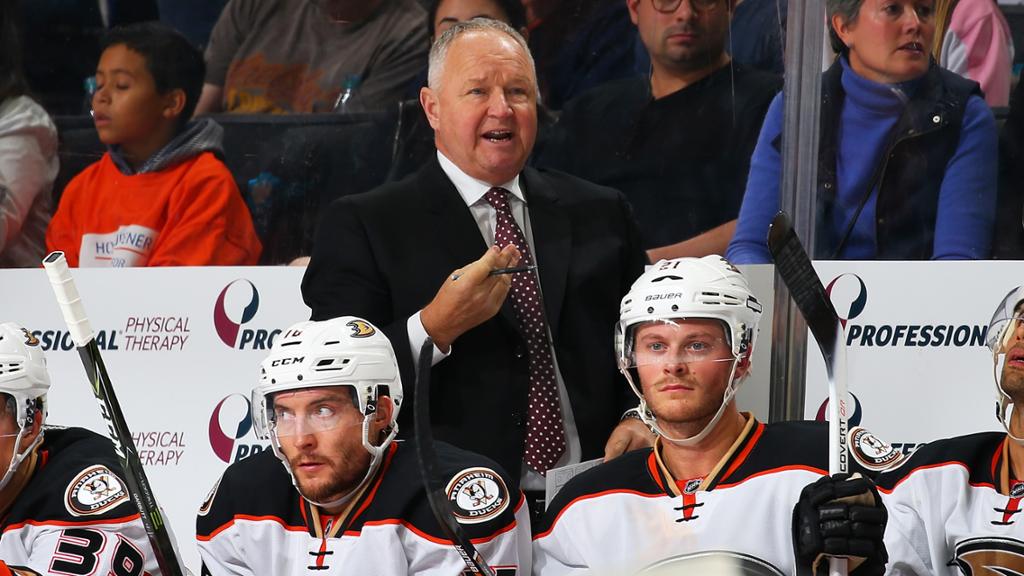
1. Randy Carlyle
One of the most recognizable names in NHL history, both for playing and for coaching, is Randy Carlyle.
Randy began his NHL career by playing for the Toronto Maple Leafs (and some games for the Dallas Black Hawks) from 1976-78. From there, Randy played for the Pittsburgh Penguins until 1984, then he played for the Winnipeg Jets until 1993, capping off an impressive 17-year professional playing career.
In total, Carlyle dressed for over 1,000 NHL games. He also won the James Norris Memorial Trophy during the 1980-81 season as the NHL’s best defenseman.
Immediately following his esteemed playing career, Carlyle switched to coaching, acting as the head coach for various NHL and IHL teams over the next 26 years. Carlyle coached the Winnipeg Jets, the Washington Capitals, the Anaheim Ducks, the Toronto Maple Leafs, and the IHL’s Manitoba Moose. Talk about a breadth of experience!
Combined with his playing career, Randy Carlyle spent 43 years active in the NHL!
2. Patrick Roy
Patrick Roy, nicknamed “Saint Patrick,” is considered one of the best NHL goaltenders of all time, which explains why he had successful playing and coaching careers.
Roy was drafted to play for the Montreal Canadiens in 1984, where he spent 11 seasons as one of the strongest goalies in the NHL. Roy was traded to the Colorado Avalanche in the 1995-96 season after hefty arguments with Montreal’s new head coach, Mario Tremblay. Roy played for the Avalanche until 2003, when he announced his retirement after a 19-year playing career.
Roy then served as the head coach for the Quebec Ramparts of the QMJHL from 2005-2013, making a brief return to the NHL as the head coach of the Colorado Avalanche from 2013-2016, succeeding Joe Sacco.
Roy is one of the most decorated players in NHL history. He won four Stanley Cups during his playing career, he received the Conn Smythe Trophy three times (the only NHL player to ever do so), and was inducted into the Hockey Hall of Fame in November 2006. During the 2013-14 season as head coach of the Avalanche, Roy won the Jack Adams Award as the NHL’s best coach. To top it all off, Roy was chosen as the “greatest goaltender in NHL history” in 2004 by a panel of sports writers and a fan poll.
Although Patrick Roy isn’t currently active in the NHL, he made a contribution that will long outlive his already impressive pro hockey career. Roy popularized the “butterfly” style of goaltending, in which a goalie drops to his knees to defend the lower portion of the net by aligning his pads horizontally. Today, the butterfly style of goaltending is by-far the most common technique for goalies.
3. Joe Sacco
Joe Sacco is one of two Sacco brothers (the other being David Sacco) to have played in the NHL.
Joe spent 13 years playing for 5 different NHL teams. He played for the Toronto Maple Leafs from 1990-1993, the Anaheim Ducks from 1993-1998, the New York Islanders from 1998-1999, the Washington Capitals from 1999-2002, and spent a final season with the Philadelphia Flyers in 2002-03.
After his retirement in 2003, Joe spent a few years coaching AHL teams before acting as the head coach of the Colorado Avalanche for four seasons from 2009-2013. During his time as head coach, Joe was nominated for the Jack Adams Award. In 2013, Sacco was succeeded by Patrick Roy as the new head coach of the Avalanche.
On July 24, 2014, Joe was hired by the Boston Bruins as an assistant coach, a position he’s held ever since.
4. Bryan Trottier
Bryan “Trots” Trottier was drafted as a centre for the New York Islanders in 1974. Trottier stayed with the Islanders until 1990, for 15 seasons, during which he became known for his offensive success.
In 1978, Trottier set the NHL record for the most points scored in a single period (4 goals and 2 assists). He is also one of few NHL players who have scored 5 or more goals in multiple games. In the 1978-79 season, Trottier scored a total of 134 points, earning him the Art Ross Trophy as the NHL’s top scorer. He also picked up the Hart Memorial Trophy the same year as NHL MVP and won the Conn Smythe Trophy as the playoff MVP the following season.
Of course, Trottier’s individual success translated to team success. He managed to win a whopping 4 Stanley Cups while playing for the Islanders.
After 1990, Trottier played another 3 seasons for the Pittsburgh Penguins before announcing his retirement in 1994. At the time Trottier retired, he had scored the sixth-most points in NHL history.
Unfortunately, Trottier’s coaching career wasn’t as successful as his playing career. After retiring as a player, Trottier served as the assistant coach for the Pittsburgh Penguins (1994-1997) and the Colorado Avalanche (1997-2001). In 2002, he was named the head coach of the New York Rangers, but was promptly fired after only half a season because he faced franchise and fan backlash for his misuse of the team’s offensive players.
Trottier later served as the assistant coach of the Buffalo Sabres in the 2014-15 season.
Although Trottier’s coaching career is less illustrious, he’ll always be remembered as one of the greatest players in NHL history.
If you’re disappointed by the suspension of the NHL season due to the COVID crisis, imagine what the actual players are feeling. These are some of the fiercest competitors in the world, and their season was cut short just before the always-intense playoffs were set to begin. On top of their passion for the sport, playing the game is also their career, so they are currently without work.
The good news is that just like us, NHL players are well-rounded individuals with a variety of interests and capabilities. As professional athletes, they are also in a relatively fortunate position as far as having the funds and professional networks to help with humanitarian initiatives during the crisis. Many players have been spending their time helping others and keeping fans engaged during these trying times.
Players Getting Creative with Donations
Many players have taken it upon themselves to donate to organizations to help victims of COVID and to fund research that can slow the spread of the disease. Aside from simply donating money, it is popular for players to donate signed memorabilia and other items to be auctioned off at charity events whose proceeds will be donated to COVID relief.
John Klingberg of the Dallas Stars donated a signed Winter Classic jersey to the Center for Disaster Philanthropy. The CDP currently has an auction geared specifically for COVID-19 relief, and has raised over $160,000 by auctioning off jerseys, artwork, game-used goods, and other desirable items. Other NHL Stars who have donated items to this fund include Marc-Andre Fleury of the Golden Knights, Rickard Rakell of the Anaheim Ducks, and Bryan Rust of the Pittsburgh Penguins.
Many players and teams that already have their own charitable donations are expanding their funds and designated certain amounts to help COVID victims and to fund research for a cure. There are many wonderful philanthropic efforts going on across the league, and it is encouraging for young fans to see their idols stepping up and making a difference in the world.
In addition to donations directly sent to COVID relief funds, some players are making sure that team employees are taken care of. While many teams have announced that team and arena employees will be compensated during the suspension, individual players have also made contributions. Sergei Bobrovsky of the Panthers gave $100,000 of his own money to help pay employees of the BB&T Center, sparking all of his Panther teammates to do the same.
It is uplifting to see professional athletes going above and beyond to ensure the health and well-being of everyone around them.
Fan Interactions
Hockey players are well aware that the league couldn’t exist without the fans, so they are doing their part to keep them entertained during this time when hockey can’t be played. In a normal situation, players could host meet-and-greets and real-life events for fans, but with social-distancing guidelines and quarantine requirements, that isn’t possible. In light of this, many players have taken to social media to keep the fans engaged.
This isn’t just a way for players to stay in contact with fans, but also a good opportunity for them to spread awareness and educate people on what to do during these times. Morgan Rielly of the Maple Leafs shared a video showing proper handwashing techniques and added some humorous quips in during the video. Zach Hyman, also of the Maple Leafs, posted a video encouraging people around the world to practice social distancing and to be extra-cautious during these uncertain times.
Calgary Flames’ forward Matthew Tkachuk took to social media to post a FaceTime call he had to wish happy birthday to a fan whose party was cancelled due to Coronavirus. Many other players shared fun and informative videos of them performing impressive feats of skill in their own home or thanking the first responders and medical workers who are fighting on the frontlines of the crisis.
New Forms of Entertainment
While some players are interacting directly with fans on social media, others are taking on new forms of entertainment so that thousands of fans can join in on the fun. Just recently, PK Subban of the New Jersey Devils announced that he would be hosting a 30-minute weekly show called NHL Hat Trick Trivia.
Subban will film his part remotely from his home, while contestants every week will also be filmed in theirs, with a guest star showing up every week. For every question answered correctly, contestants will receive a prize – a hat for the first question, a jersey for the second, and two NHL tickets for the third. They must be careful, however, as a wrong answer means that they will lose everything.
Subban is a big personality who hasn’t always endeared himself to fans of opposing teams, but he makes a great candidate for a game show host as he is well known around the league and provides an energetic demeanor. Perhaps he’ll be able to make fans of contestants who formerly considered him a rival.
A Higher Level of Social Responsibility
Although hockey may be a sport that is ultimately here for entertainment purposes, many stars feel that they have a heightened responsibility to contribute to causes that will help the world. They are in the public eye and many young people look up to them as heroes. Because of their status as public figures, they should strive to make strong examples to people across the world and to do the right thing.
It isn’t just about donating part of your salary to charity, but also about taking the time to help with relief efforts and striving to be upstanding citizens now that they have the time to do so. NHL players are showing that they are truly wonderful members of society by continually interacting with their fans and encouraging proper behavior during these difficult times. These players aren’t required to do any of this, but they are exhibiting to the world that the NHL is a league with plenty of class.
Hockey is an incredibly fun game. Groups of kids play on frozen ponds in the winter, fathers play in beer leagues to let off some steam after work, and millions of fans gather every weekend to watch their favorite NHL team on television.
But while hockey is fun, it’s also extremely competitive. The goal of most hockey players, no matter the age or skill level, is to train, improve, and rise in the ranks to ultimately play in the NHL. To make it to the highest level of play, however, you need certain skills and habits that have been practiced and fine-tuned over the course of years.
Well, what are those skills and habits? What things should you work on to give yourself the best chance to improve and take your game to the next level?
Sure, you should have a good attitude and always try your hardest. But I’m talking about more game-specific things—-things you can actively practice on and off the ice until they become second nature. Here are the 5 most common habits among successful hockey players:
Good Body Position
Good body position is crucial to your success as a hockey player. It can be broken down into two categories: personal and relative.
Personal body position refers to your physical posture. To have good personal body position, you should:
Bend your knees to maintain a low centre of gravity
Keep your feet hip-width apart
All these habits contribute to staying aware and ready to react to any situation on the ice. If you work on developing proper posture, it’ll soon become habitual and you won’t need to think about it anymore.
Relative body position refers to where you are on the ice compared to all the other players. It’s important to position yourself so that, even if you don’t have the puck, you can still affect the play in the best way possible.
Having good relative body position involves:
Using your body to block the trajectory of shots on your net
Getting in the way of enemy forwards when they have puck possession
Placing yourself open and available for passes if needed
Constant Movement
You should always keep your feet moving. Plain and simple.
Why? Well, what’s the difference between a player who’s actively skating towards the puck and one who’s just standing an watching the action? The first player has an objective and the second one doesn’t.
In hockey, you should always have an objective. Pay attention and quickly decide how you can best help your team in the moment (hint: it’s never by standing still and watching the action). As a result, you should always keep your feet moving towards your goal. Plus, if you maintain movement and a low centre of gravity, it’ll be easier for you to react to changes in puck possession and other potential surprises.
Communication
Communication is an important habit if you want to become a successful hockey player.
If you watch any NHL game, the players on the bench are always talking. Communication is key. When you’re not on the ice, you should always be discussing the game and potential strategies with your teammates. Or, you should be calling out to the players on the ice with helpful suggestions, which you can only do if you’re paying attention to the game.
Even while you’re on the ice you should be communicating as effectively as possible. If you notice an opportunity for one of your teammates, call it out to them. If you notice one of your teammates is out of position or making any sort of mistake, let them know.
Sure, some players aren’t used to calling out for the puck or shouting suggestions at their teammates, but you must get comfortable with it. Often, communication skills mean the difference between a win and a loss in a hockey game.
Always Think Through a Play
This habit is an extension of the “always have an objective” idea.
Professional hockey players assess every situation before rushing with the puck, making a check, or positioning themselves elsewhere on the ice. Hockey is a fast game, so the assessment must be made quickly, but in professional hockey it always happens. Thinking through a play allows you to avoid making costly mistakes that end up with you being out of position and granting the opposing team an opportunity to advance the puck and score.
Before repositioning yourself or making any sort of play, assess the situation. Where are your teammates and the opposing players located on the ice? Where is the puck likely to head? It is best to skate into traffic, or to position yourself elsewhere.
If you make it a habit to think through each play, you can trust that you’re making sound decisions. Then, you’ll notice that you’ll influence your games in a much more notable and positive way, helping to elevate your vision and hockey I.Q.
Good Nutrition
All high-level hockey players take excellent care of their bodies. Good nutrition can be separated into three things: sleep pattern, eating habits, and exercise.
In terms of sleep, make sure you’re consistently getting at least seven hours of sleep at night—-the more you get, the better. And that goes for every night, too, not just nights before practices or games. In addition, try your best to go to bed and wake up around the same time each night. If you set a pattern for your sleep, your body will become used to it. Then, you’ll fall asleep faster and wake up feeling more well-rested.
Also, ensure you’re eating healthy. It’s okay to treat yourself occasionally, but if you want to become a top-notch athlete, you’ll need to fuel your body properly. Stick to veggies, carbs, and lean protein. Drink plenty of water throughout the day and try to refrain from eating a lot before bed.
Lastly, exercise. NHL players exercise more than just during practices and games. Perhaps join another sport in addition to hockey for some extra exercise. Maybe go for a half-hour jog every second night or go to the gym a few times a week. To become an elite hockey player, you need to make sure your body is in peak physical condition so you can perform your best on the ice. The hard work you do in the gym should transition onto the ice.
There you have it: 5 of the most common habits of successful hockey players.
Of course, these aren’t the only things you need to work on to become a high-level hockey player. There are many skills and techniques that must be practiced in order to compete in elite hockey. Plus, you also need great work-ethic and immense dedication to the sport to succeed.
These 5 habits are a fantastic start, however. Work on body position, maintaining constant movement, communication, thinking through plays, and keeping good nutrition, and you should see rapid, notable improvement in your game.
Always strive to do your best, but remember to have fun, too. Hockey is a game, and it’s meant to be enjoyed by all those who play it. So, whether you want to make the NHL or just play minor hockey as a hobby, make sure to enjoy yourself along the way.